EUROPEAN YOUTH MEETING - PROGRAMME STRUCTURE
E--PRESENTATIONS AND EXHIBITIONS
MAKING PROCESSES VISIBLE
Sharing responsibility / Continuing the dialogue.
Presentations and exhibitions form the public and reflective conclusion of the creative meeting and the wider project period. They translate the intensive internal processes of workshops, discussions, and excursions into shared moments of visibility, accountability, and dialogue.
The focus lies not on polished final products, but on processes, learning paths, and collective responsibility. Participants are not only contributors, but also co-authors of the project’s public narrative.
E1 — Final Public Presentation at the End of the Creative Meeting
At the end of the summer creative meeting, a public presentation event is organised.
Participants, workshop facilitators, and team leaders present the development and outcomes of the various workshops to invited guests.
The presentation is conceived as:
• a shared reflection on the camp process
• a dialogue with the local community
• an invitation to engage with the themes explored
.
E2 — POST MEETING Media-Based Documentation and Reflection
The project does not end with the physical return home.
Participants share responsibility for the continuation and dissemination of the project’s outcomes in their home contexts.
This phase strengthens ownership, accountability, and long-term impact.
E2.1 — Questionnaires and Evaluation
Participants contribute to:
• completing and evaluating feedback questionnaires
• reflecting on learning outcomes and personal development
This evaluation is not only administrative but also reflective, helping participants articulate what they have learned and how it has affected them.
E2.2 — Illustrated Workshop Reports
Each national or regional group prepares illustrated workshop reports, combining:
• short explanatory texts
• photographs and visual material
• selected participant statements
These reports document both artistic processes and learning experiences.
E3 — ARTISTIC EVALUATION AND EXHIBITIONS
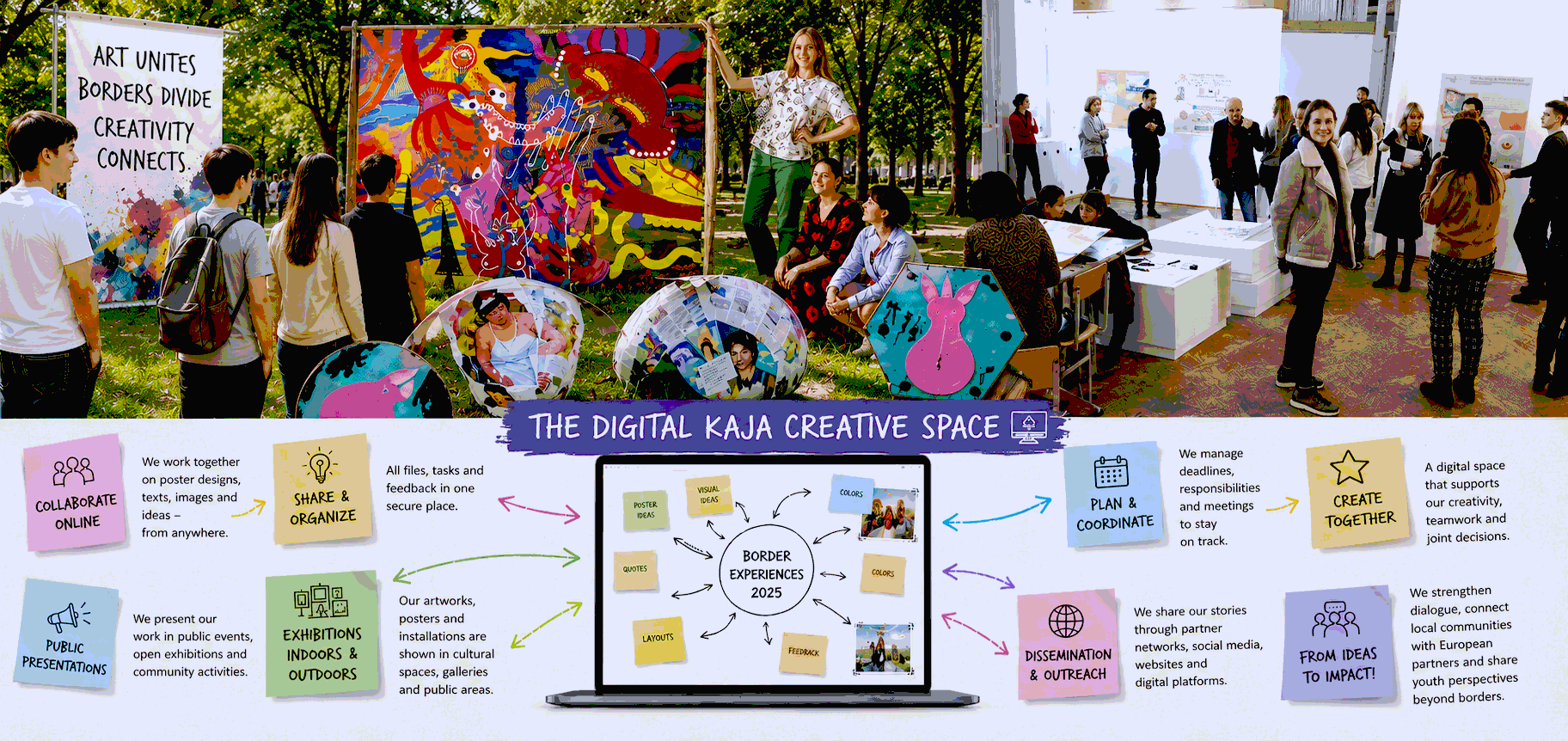
E3.1 KAJA virtual project space: Participants collaboratively work together to design up to 20 exhibition posters that:
• present key themes and artworks
• are suitable for exhibitions in youth centres, cultural institutions, and educational settings
Poster design becomes an extension of the artistic process, translating complex content into accessible visual formats.
E3.2 — Local Exhibitions and Presentations
Exhibitions and presentations take place:
• in the participants’ home towns
• at youth organisations
• at educational institutions
These events allow participants to:
• share experiences with peers and communities
• create local dialogue around European themes
• strengthen youth-led cultural initiatives
E4 — DEVELOPMENT OF FOLLOW-UP PROJECTS IN 26/28
Development of Follow-Up Projects
Participants are encouraged to:
• develop ideas for follow-up activities
• build on partnerships established during the project
• explore future Erasmus+ or local initiatives
Guests may include:
• local partners and institutions
• representatives of youth organisations
• cultural actors
• interested members of the public
Format
The presentation may combine:
• short verbal introductions to each workshop
• visual documentation (photos, videos, projections)
• performative elements (music, readings, performances)
• guided walks through installations or exhibition spaces
Each workshop is presented one after another, allowing participants to explain not only what was created, but why and how.
E2 — POST MEETING Media-Based Documentation and Reflection
The project does not end with the physical return home.
Participants share responsibility for the continuation and dissemination of the project’s outcomes in their home contexts.
This phase strengthens ownership, accountability, and long-term impact.
E2.1 — Questionnaires and Evaluation
Participants contribute to:
• completing and evaluating feedback questionnaires
• reflecting on learning outcomes and personal development
This evaluation is not only administrative but also reflective, helping participants articulate what they have learned and how it has affected them.
E2.2 — Illustrated Workshop Reports
Each national or regional group prepares illustrated workshop reports, combining:
• short explanatory texts
• photographs and visual material
• selected participant statements
These reports document both artistic processes and learning experiences.
E1 — Final Public Presentation at the End of the Creative Meeting
At the end of the summer creative meeting, a public presentation event is organised.
Participants, workshop facilitators, and team leaders present the development and outcomes of the various workshops to invited guests.
The presentation is conceived as:
• a shared reflection on the camp process
• a dialogue with the local community
• an invitation to engage with the themes explored
Guests may include:
• local partners and institutions
• representatives of youth organisations
• cultural actors
• interested members of the public
Format
The presentation may combine:
• short verbal introductions to each workshop
• visual documentation (photos, videos, projections)
• performative elements (music, readings, performances)
• guided walks through installations or exhibition spaces
Each workshop is presented one after another, allowing participants to explain not only what was created, but why and how.
E2 — POST MEETING Media-Based Documentation and Reflection
The project does not end with the physical return home.
Participants share responsibility for the continuation and dissemination of the project’s outcomes in their home contexts.
This phase strengthens ownership, accountability, and long-term impact.
E2.1 — Questionnaires and Evaluation
Participants contribute to:
• completing and evaluating feedback questionnaires
• reflecting on learning outcomes and personal development
This evaluation is not only administrative but also reflective, helping participants articulate what they have learned and how it has affected them.
E2.2 — Illustrated Workshop Reports
Each national or regional group prepares illustrated workshop reports, combining:
• short explanatory texts
• photographs and visual material
• selected participant statements
These reports document both artistic processes and learning experiences.
E3 — ARTISTIC EVALUATION AND EXHIBITIONS
E3.1 KAJA virtual project space: Participants collaboratively work together to design up to 20 exhibition posters that:
• present key themes and artworks
• are suitable for exhibitions in youth centres, cultural institutions, and educational settings
Poster design becomes an extension of the artistic process, translating complex content into accessible visual formats.
E3.2 — Local Exhibitions and Presentations
Exhibitions and presentations take place:
• in the participants’ home towns
• at youth organisations
• at educational institutions
These events allow participants to:
• share experiences with peers and communities
• create local dialogue around European themes
• strengthen youth-led cultural initiatives
E4 — DEVELOPMENT OF FOLLOW-UP PROJECTS IN 26/28
Development of Follow-Up Projects
Participants are encouraged to:
• develop ideas for follow-up activities
• build on partnerships established during the project
• explore future Erasmus+ or local initiatives
E5--COMPETENCES INFORMAL LEARNING AND YOUTHPASS:
Participants also reflect collectively on competences, artistic development and intercultural learning within the Youthpass process. Presentation, evaluation and dissemination are understood as shared responsibilities and as part of the overall educational experience.
The activity area encourages participants to become active co-authors of the project’s public narrative while strengthening visibility, sustainability and international exchange beyond the duration of the meeting..